Payment reliability engine

Stopping $46M in Fraud Before It Happens

Role

Product Designer : System & UX Design

Focus

Real-time fintech risk, fraud prevention, payment monitoring

Industry

Fintech /B2B SAAS

Outcome

A system that does not just monitor, it prevents problems before they happen.
The problem

Money doesn’t move in a straight line. In modern fintech, it passes through:

• APIs

• Banks

• Payment processors

• Queues, retries, and ledgers


Every step is a potential failure point:

• Stuck payments

• Silent losses

• Insider manipulation

• Fraud


Most fintech teams only notice these issues after the fact:

• Customers complain

• Reconciliation fails

• Money disappears

• Engineers and finance scramble

This leads to lost revenue, broken trust, and regulatory risk.


The real problem wasn’t just fraud, it was invisibility. Teams couldn’t see:

• Where money actually is

• Which banks are failing

• Which transactions are at risk

• How to recover funds fast

Design Challenge

Design a system that gives fintech companies complete visibility and control over every transaction in real time.


Requirements:

• Detect stuck or failed transactions

• Identify suspicious activity, including insider risk

• Provide actionable recommendations for recovery

• Surface high-level insights for executives

• Work for non-technical and technical users alike

Design a system that gives fintech companies complete visibility and control over every transaction in real time.

Requirements:

• Detect stuck or failed transactions

• Identify suspicious activity, including insider risk

• Provide actionable recommendations for recovery

• Surface high-level insights for executives

• Work for non-technical and technical users alike

Users

Users

The Payment Reliability Engine serves three layers of users:

1. Executives (CEO, CFO)

• High-level operational health

• Financial exposure & risk

• Decision signals without logs or tables


2. Finance & Risk Teams

• Detect high-risk transactions

• Spot anomalies and systemic failures

• Recover funds quickly


3. Engineers & Operations

• Understand failures in real time

• Fix technical or process issues

• Track impact of errors

Users

The Payment Reliability Engine serves three layers of users:

1. Executives (CEO, CFO)

• High-level operational health

• Financial exposure & risk

• Decision signals without logs or tables


2. Finance & Risk Teams

• Detect high-risk transactions

• Spot anomalies and systemic failures

• Recover funds quickly


3. Engineers & Operations

• Understand failures in real time

• Fix technical or process issues

• Track impact of errors

Core UX Insight

Core UX Insight

Raw transaction data is useless, users need answers, not logs:

• Where is the money?

• Is it safe?

• Is it recoverable?

• What should I do right now?

This insight drove every design decision.

Key Screens & Features

  1. Executive Overview

Purpose: Give leadership confidence in the health of the business in under 10 seconds.

Design decisions:

• High-level metrics only (no noise)

• Color-coded risk signals

• Trend visualization of stuck vs successful transactions

2. Live Transaction Map

Purpose: Show real-time flow of money through banks, processors, and internal ledgers.

Design decisions:

• Animated paths indicate movement

• Red = stuck / failed

• Green = healthy

• Hover for transaction details

This gives engineers and risk teams instant awareness.

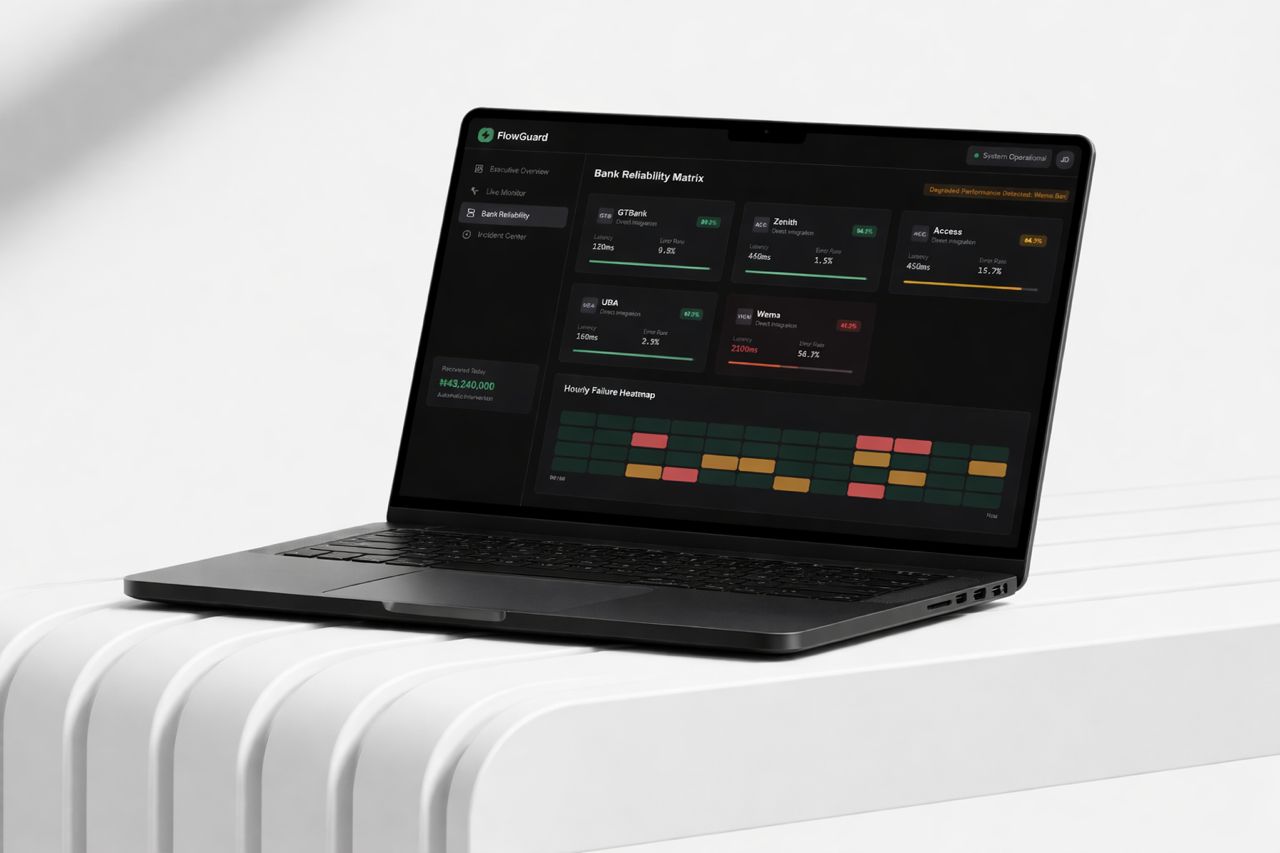
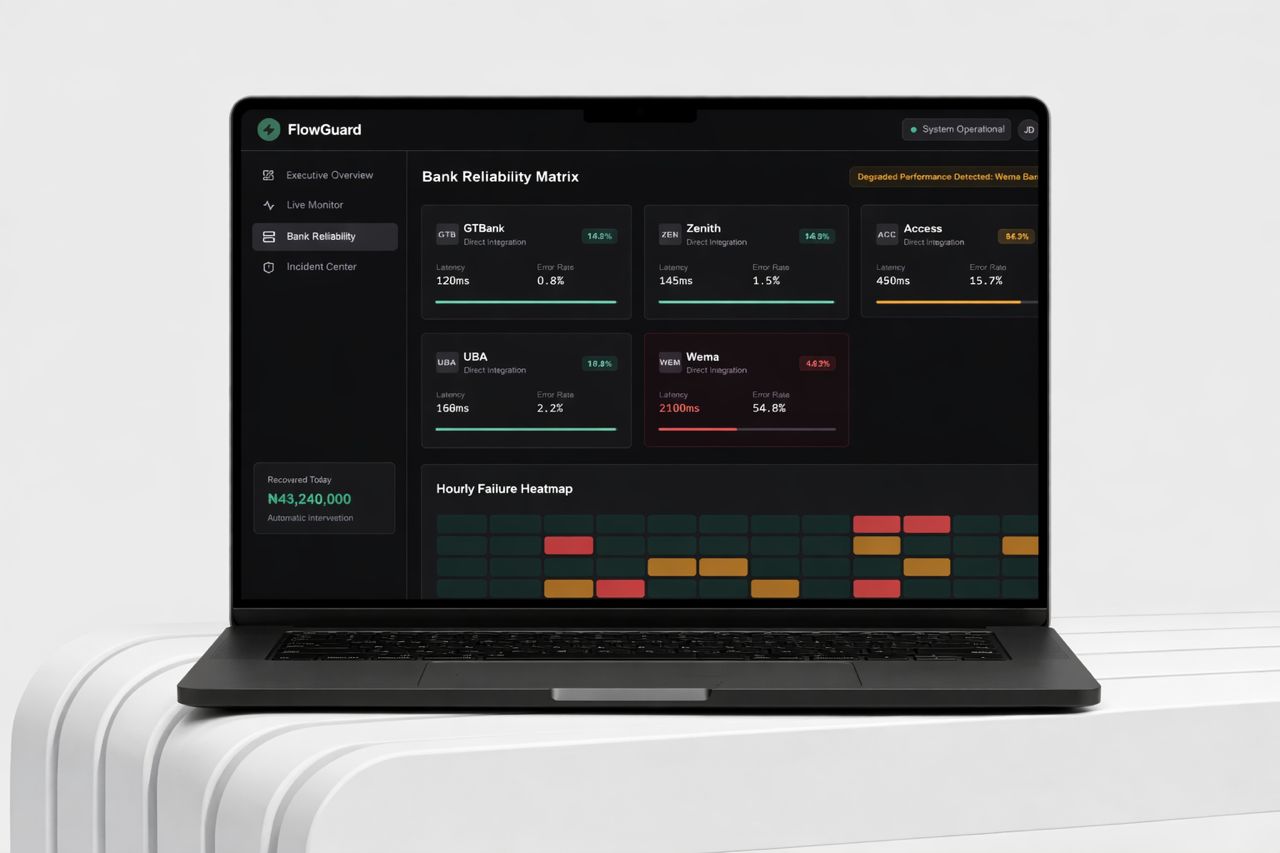
3. Bank Reliability Dashboard

3. Bank Reliability
Dashboard

Purpose: Identify which financial institutions are failing repeatedly.

• Track success/failure rates

• Historical patterns for rerouting

• Immediate decision-making for risk mitigation

4. Incident Center

Purpose: Turn problems into actions.

• Flagged transactions are ranked by financial impact

• Recommended actions: reroute, retry, reverse, freeze

• Track resolution history

This ensures no silent losses and prevents insider manipulation.
Micro-Interactions

Micro-Interactions

• Transactions pulse when moving

• Fade when frozen or completed

• Highlight suspicious transactions dynamically

• Alerts trigger subtle motion, not pop-ups

These interactions make the invisible visible, reinforcing urgency and trust.

Design Principles

1. Problems Before Complaints – Flag risks before they hit the customer

2. Action-First UX – Every alert tells the user what to do

3. Clarity Over Decoration – Typography, color, and hierarchy reduce cognitive load

4. System Visibility – No transaction is invisible; every change is logged

5. Financial Impact as Priority – Users see risk in money, not just data points

Business Impact

• Millions of dollars protected before loss

• Silent revenue leakage eliminated

• Faster risk response for teams

• Trust restored with clients and regulators

• Prevention of insider fraud

Outcome: A system that does not just monitor, it prevents problems before they happen.

Final Reflection

This is not just about screens.

It demonstrates:

• Systems thinking: connecting multiple APIs, banks, and internal ledgers

• UX for high-stakes decisions: actionable clarity for technical & non-technical users

• Visual language with purpose: color, typography, spacing = decision support

• Revenue-first thinking: design directly protects business outcomes

This is the kind of work that top fintech, B2B SaaS, and enterprise companies pay for.

Good product design doesn’t just make interfaces look good.

It prevents millions from disappearing, protects trust, and enables confident decision-making.

FlowGuard is proof that design can directly protect a business’s bottom line.

Let’s build something users trust

I’m open to freelance, contract, and full-time opportunities. If you’re building a product and need clear UX, strong UI, and thoughtful user flows, let’s talk.

Let’s build something users trust

I’m open to freelance, contract, and full-time opportunities. If you’re building a product and need clear UX, strong UI, and thoughtful user flows, let’s talk.

Let’s build something users trust

I’m open to freelance, contract, and full-time opportunities. If you’re building a product and need clear UX, strong UI, and thoughtful user flows, let’s talk.

2. Live Transaction Map

Back

Micro-Interactions

Micro-Interactions

• Transactions pulse when moving

• Fade when frozen or completed

• Highlight suspicious transactions dynamically

• Alerts trigger subtle motion, not pop-ups

These interactions make the invisible visible, reinforcing urgency and trust.

Design Principles

1. Problems Before Complaints – Flag risks before they hit the customer

2. Action-First UX – Every alert tells the user what to do

3. Clarity Over Decoration – Typography, color, and hierarchy reduce cognitive load

4. System Visibility – No transaction is invisible; every change is logged

5. Financial Impact as Priority – Users see risk in money, not just data points

Create a free website with Framer, the website builder loved by startups, designers and agencies.