Role
Product Designer
Duration
4 month
Industry
E-commerce
Focus
Product Strategy, UX/UI, Mobile App & Operations
Role
Product Designer
Duration
4months
Industry
E-commerce
Focus
Product Strategy, UX/UI, Mobile App & Operations
The challenge
Building Hook wasn’t simply about putting products online.
Traditional e-commerce experiences like Alibaba and Temu are often built around organised inventory: products are catalogued, stored and shipped through controlled fulfilment systems.
Hook works differently.
Its products come from real vendors operating inside busy physical markets. Availability and prices can change. Products must be located, verified and sourced before they reach the customer.
That created a different product challenge:
How do you translate the experience of shopping in a physical African market into something that feels natural on a phone?
Building Hook wasn’t simply about putting products online.
Traditional e-commerce experiences like Alibaba and Temu are often built around organised inventory: products are catalogued, stored and shipped through controlled fulfilment systems.
Hook works differently.
Its products come from real vendors operating inside busy physical markets. Availability and prices can change. Products must be located, verified and sourced before they reach the customer.
That created a different product challenge:
How do you translate the experience of shopping in a physical African market into something that feels natural on a phone?
The Approach
Recommnded an offline Approach first
Before designing the app, I recommended starting offline.
I wanted to understand how people actually shop in African markets, how vendors operate, how products are found, and where friction occurs between finding the right item and getting it to the customer.
This helped me understand the business side very well.
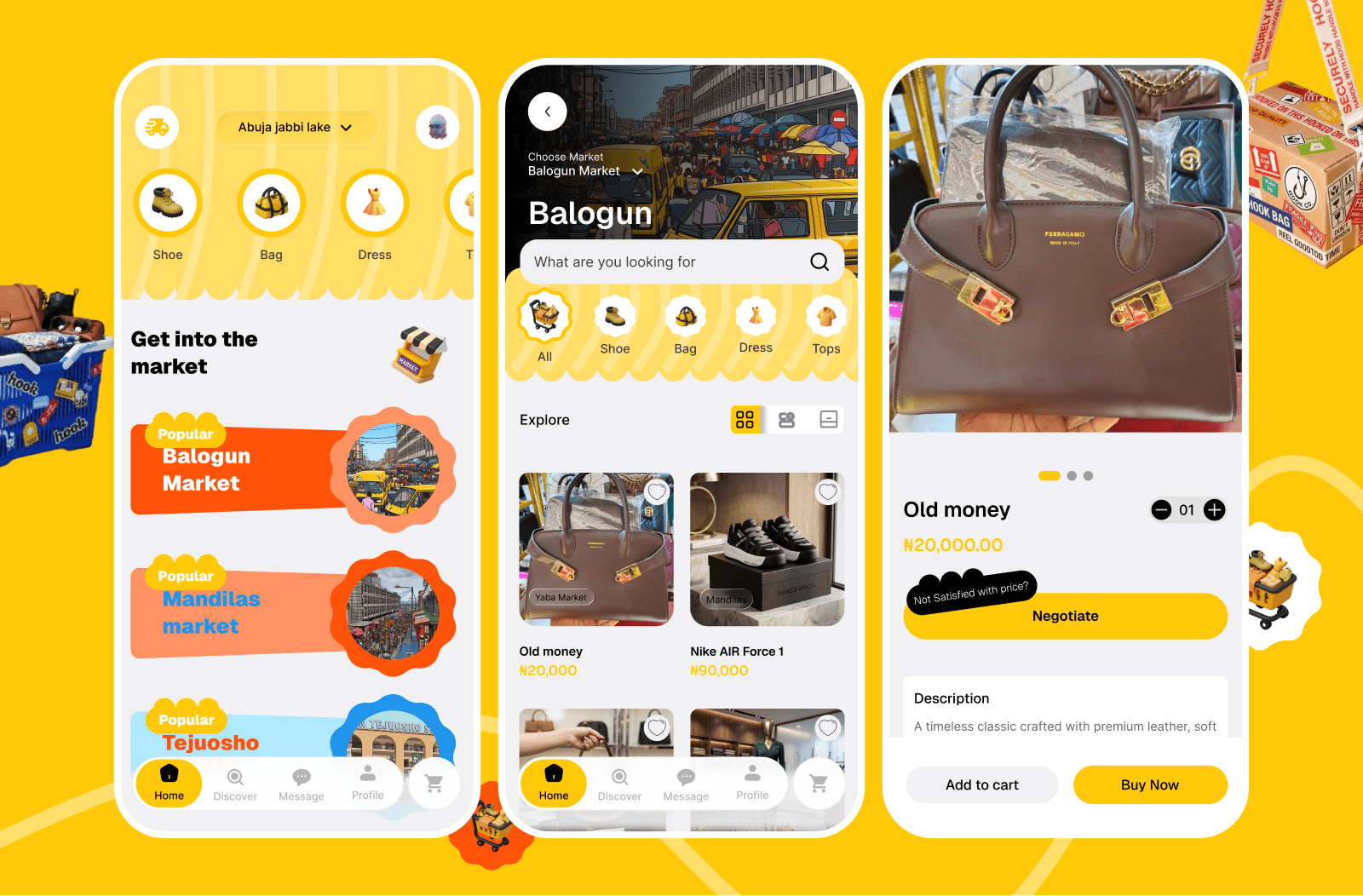
Instead of following the usual app model used by Temu and Alibaba, where customers see products first and check out afterward, I designed Hook around how Africans shop: users first choose the market they want to shop from, then explore the products available there.
This wasn’t just an assumption; it was something I discovered through data while Hook operated offline.
The Approach
The Approach
Recommnded an offline Approach first
Before designing the app, I recommended starting offline.
I wanted to understand how people actually shop in African markets, how vendors operate, how products are found, and where friction occurs between finding the right item and getting it to the customer.
This helped me understand the business side very well.
Instead of following the usual app model used by Temu and Alibaba, where customers see products first and check out afterward, I designed Hook around how Africans shop: users first choose the market they want to shop from, then explore the products available there.
This wasn’t just an assumption; it was something I discovered through data while Hook operated offline.
The Approach
Key Design Decisions

Understanding the users
01 — Start With the Market
Most online marketplaces start with a product catalogue.
Hook starts with a place people already know.
Choosing a market gives users a familiar entry point and connects the physical market directly to its digital counterpart.
The market becomes more than a filter; it becomes part of the product experience.
02 — Make the Market Feel Alive
I didn’t want Hook to feel like another generic marketplace.
The visual direction uses bold colours, playful shapes, market imagery and movement to capture some of the energy of physical African markets.
The visual design wasn’t simply about making the interface look different. It was about giving the digital experience a sense of place. In fact, the design structure was made to resemble market shops.
03 — Build Trust Around Real-World Inventory
Shopping at a physical market through a phone creates a different kind of uncertainty.
Users can’t physically inspect a product before ordering, so the experience needed to answer questions such as:
Is this product actually available?
Is this the exact item I’ll receive?
Has someone verified it?
What happens after I place my order?
As a designer who also considers the business, I introduced Market Associates to source items in the market, verify that they match the order, and then hand them over to logistics.
04 — Design the System, Not Just the App
The customer-facing app is only one part of Hook.
Behind every order are vendors, Market Associates and logistics partners working together to find, verify and deliver products.
I designed the product with these operational realities in mind.
The goal was to keep complexity where it belongs "behind the scenes" while giving customers a clear, predictable experience from discovery to delivery.
01 — Start With the Market
Most online marketplaces start with a product catalogue.
Hook starts with a place people already know.
Choosing a market gives users a familiar entry point and connects the physical market directly to its digital counterpart.
The market becomes more than a filter; it becomes part of the product experience.
02 — Make the Market Feel Alive
I didn’t want Hook to feel like another generic marketplace.
The visual direction uses bold colours, playful shapes, market imagery and movement to capture some of the energy of physical African markets.
The visual design wasn’t simply about making the interface look different. It was about giving the digital experience a sense of place. In fact, the design structure was made to resemble market shops.
03 — Build Trust Around Real-World Inventory
Shopping at a physical market through a phone creates a different kind of uncertainty.
Users can’t physically inspect a product before ordering, so the experience needed to answer questions such as:
Is this product actually available?
Is this the exact item I’ll receive?
Has someone verified it?
What happens after I place my order?
As a designer who also considers the business, I introduced Market Associates to source items in the market, verify that they match the order, and then hand them over to logistics.
04 — Design the System, Not Just the App
The customer-facing app is only one part of Hook.
Behind every order are vendors, Market Associates and logistics partners working together to find, verify and deliver products.
I designed the product with these operational realities in mind.
The goal was to keep complexity where it belongs "behind the scenes" while giving customers a clear, predictable experience from discovery to delivery.
Recommnded an offline Approach
Before the app launched, Hook had already validated its business model in the real world.
The offline operation was generating:
250+ daily customer inquiries
15–18 orders per day
15%+ repeat purchases
30+ vendors and logistics partners
₦20M+ in monthly revenue
These numbers gave us something valuable: proven behaviour to design around.
Rather than building a marketplace around assumptions, we were turning an existing offline shopping operation into a digital product, with real customers, vendors, orders and operational workflows already in place.
The challenge then became making that experience scalable without losing what made the physical market work.
The Result

Before the app launched, Hook had already validated its business model in the real world.
The offline operation was generating:
250+ daily customer inquiries
15–18 orders per day
15%+ repeat purchases
30+ vendors and logistics partners
₦20M+ in monthly revenue
These numbers gave us something valuable: proven behaviour to design around.
Rather than building a marketplace around assumptions, we were turning an existing offline shopping operation into a digital product, with real customers, vendors, orders and operational workflows already in place.
The challenge then became making that experience scalable without losing what made the physical market work.
Hook
Hook is a mobile marketplace that helps people shop at physical African markets without having to visit in person.
Hook
Hook is a mobile marketplace that helps people shop at physical African markets without having to visit in person.
Let’s build something users trust
I’m open to freelance, contract, and full-time opportunities. If you’re building a product and need clear UX, strong UI, and thoughtful user flows, let’s talk.
Back
Back
Let’s build something users trust
I’m open to freelance, contract, and full-time opportunities. If you’re building a product and need clear UX, strong UI, and thoughtful user flows, let’s talk.
Let’s build something users trust
I’m open to freelance, contract, and full-time opportunities. If you’re building a product and need clear UX, strong UI, and thoughtful user flows, let’s talk.