GadaHQ
GadaHQ is a modern HR and workforce management platform that helps growing companies manage people, payroll, and performance in one structured system.
Built for scale, it combines operational clarity with revenue-ready infrastructure for emerging markets.
Role
Product Designer
Industry
SAAS / HR
Outcome
The design help the team raised non-equity funding

About the Project
GadaHQ is an HR and workforce management platform built to help growing companies manage people, payroll, performance, compliance, and internal operations in one unified system.
When I joined, the product was pre-launch. The ambition was bold: build a category-defining HR platform capable of supporting enterprise clients and scaling into a multi-million dollar SaaS business.
I led the product design end-to-end, from information architecture and interaction design to design system and brand expression, across web and mobile. This was not just about designing screens, It was about designing trust, structure, and scale.
The Problem
Through stakeholder interviews, early prospect calls, and workflow audits, we identified critical gaps in the market:
1. Fragmented HR tools – Companies were juggling attendance software, payroll vendors, spreadsheets, and Slack approvals.
2. Low trust in payroll accuracy – Errors in salary computation and statutory deductions created tension between HR and employees.
3. Manual approvals and unclear roles – No structured permission hierarchy; too much reliance on informal communication.
4. Poor UX in existing tools – HR software felt heavy, outdated, and intimidating.
5. Scaling friction – Growing companies struggled to move from 20 to 200 employees without operational breakdown.
The opportunity was clear:
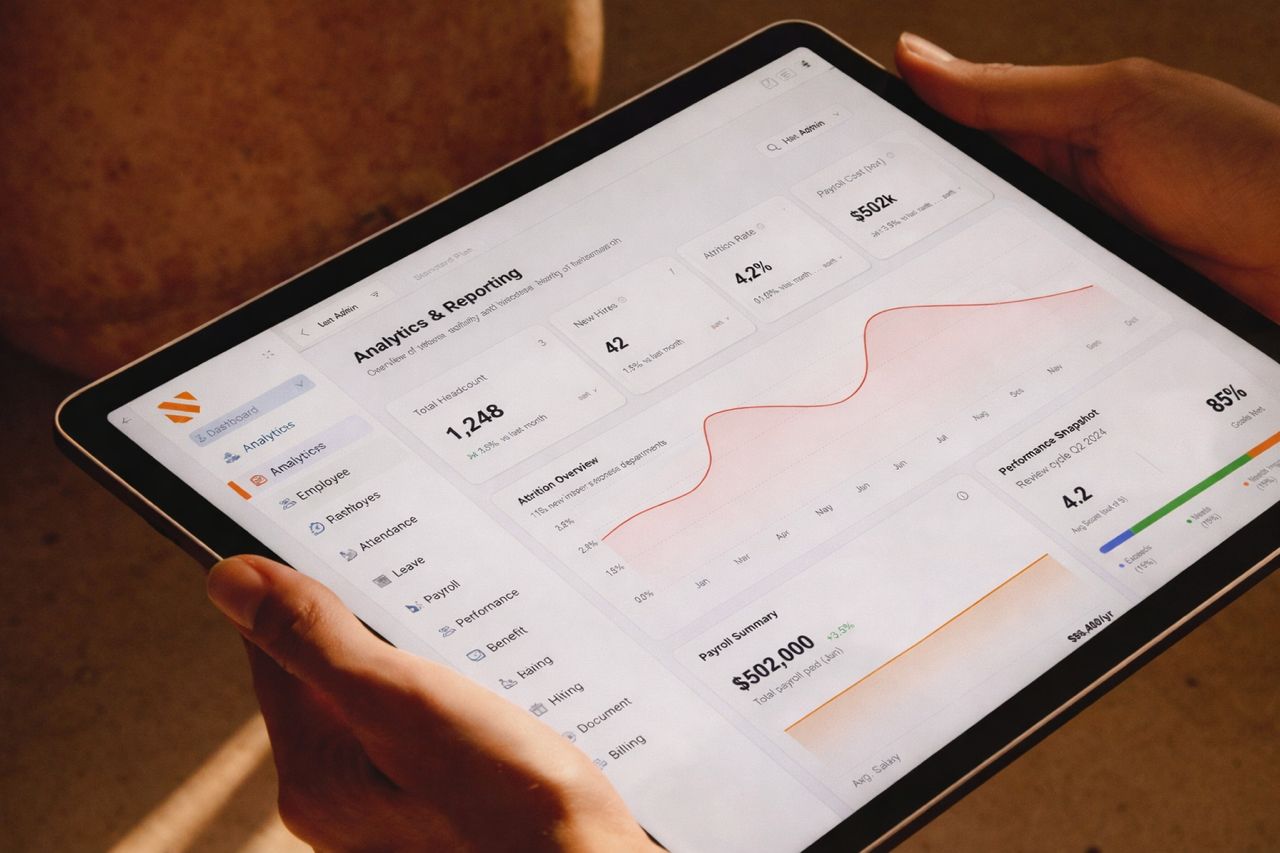
Build a clean, role-driven system that feels lightweight but operates at enterprise depth.
The Challenge
The biggest challenge wasn’t feature complexity, It was clarity.
We needed to design:
• A role-based organizational structure (Owner, Admin, Manager, Employee)
• Payroll logic with statutory compliance
• Multi-organization switching
• Modular HR components (Attendance, Leave, Performance, Hiring, Benefits)
• Enterprise-grade workflows without overwhelming users
And we had to do this in a way that:
• Feels intuitive to a non-technical HR manager
• Feels robust to a CFO
• Feels scalable to investors
This required strong information architecture and disciplined UX writing.
My Approach
Billing Dashboard (Designed for Trust & Growth)
One thing I understood early: In Nigeria and across many African markets, companies don’t naturally trust subscriptions. If billing feels rigid or unclear, they won’t commit.
So I designed GadaHQ billing system around one principle, make payment feel safe, fair, and growth-driven.
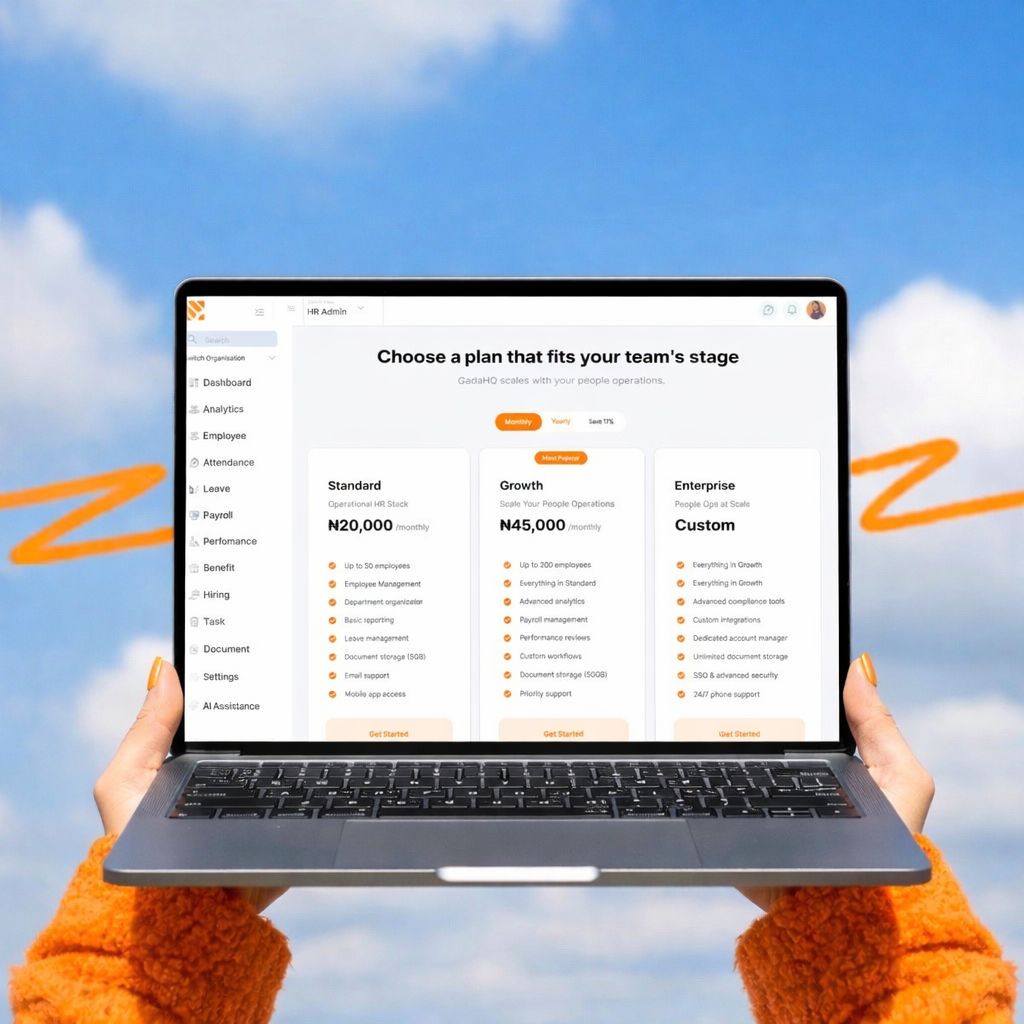
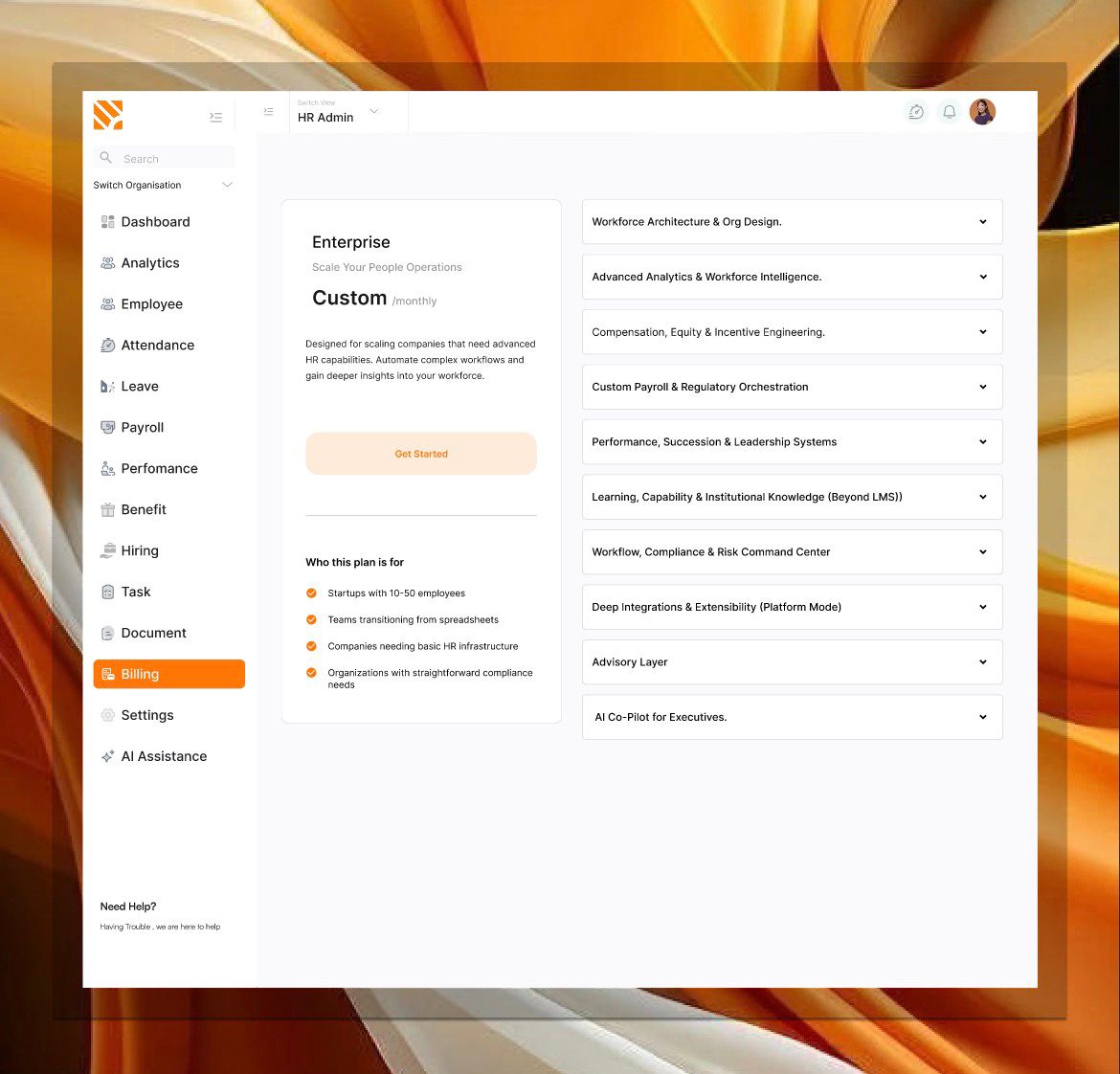
Pricing scales with employee count. As a company grows, revenue grows with it. No forced upgrades. No hidden tiers.
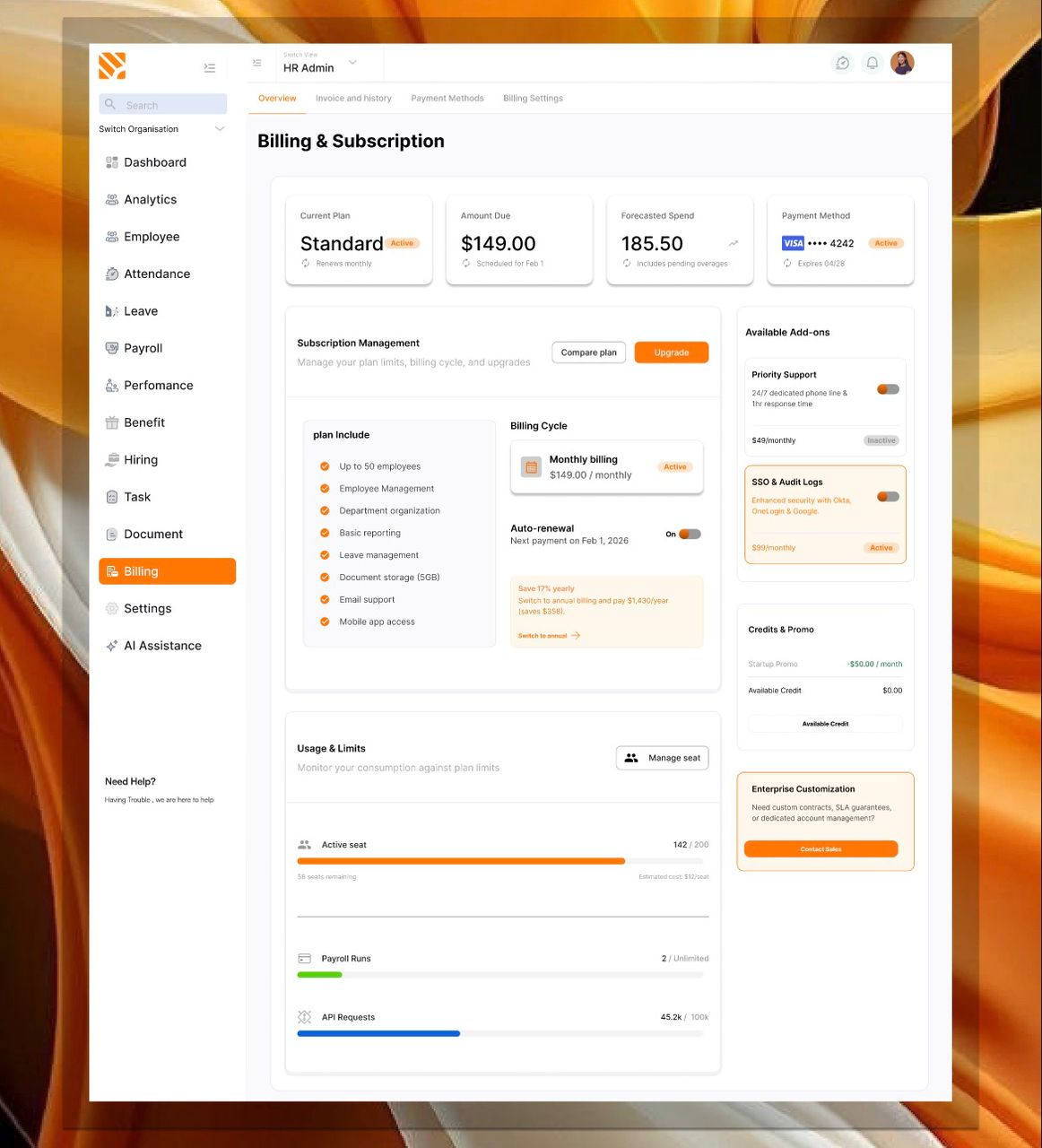
The dashboard shows everything clearly:
Current plan, live employee-based pricing, next billing date, invoices, and real-time cost changes when headcount increases.
We also supported:
• Monthly flexibility
• Discounted annual plans
• Bank transfers and invoice billing for larger companies
Upgrades are triggered by real growth milestones, not aggressive prompts. Billing doesn’t feel like a subscription trap, It feels like infrastructure that grows with you.
Navigation Built on Mental Models

I structured the platform based on how HR teams think:
Primary Operations
• Dashboard
• Employees
• Attendance
• Leave
• Payroll
People & Growth
• Performance
• Benefits
• Hiring
Support
• Tasks
• Documents
Insights
• Analytics
System
• Billing
• Settings
This reduced cognitive load and improved feature discoverability.
Payroll Experience (Standard Tier)


Payroll was designed as a controlled workflow, not just a calculation tool.
Key components:
• Salary structure builder
• Tax & statutory deduction configuration
• Monthly payroll processing timeline
• Manual approval checkpoints
• Payslip generation
• Bank file export
Instead of cluttering the UI, we created a step-by-step guided flow with validation states to reduce processing errors.
The goal: eliminate anxiety around salary runs.
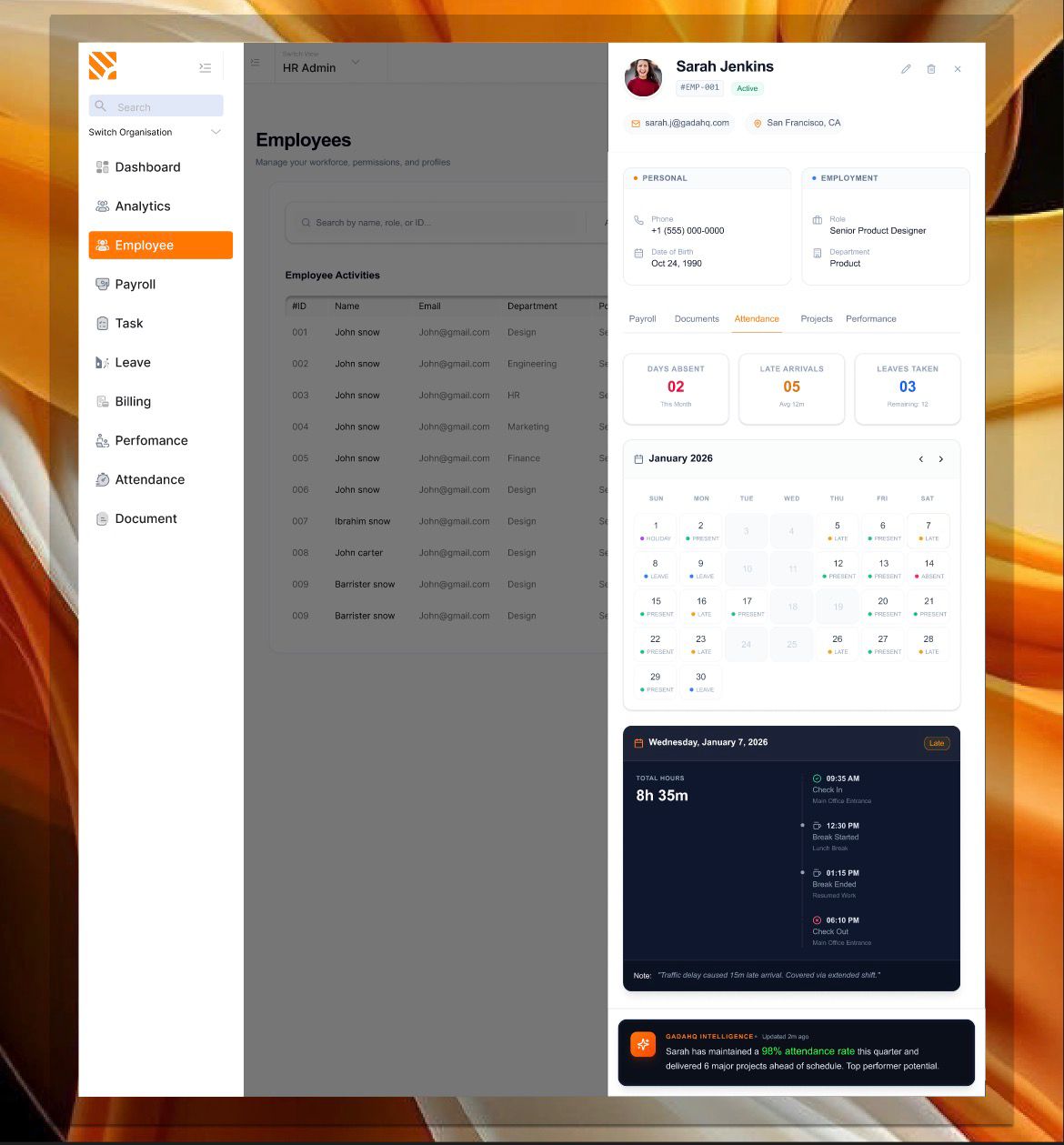
Employee Experience

The employee dashboard was designed to feel empowering, not administrative.
Employees can:
• Track attendance visually
• Submit leave with clear approval states
• View payslips transparently
• Monitor performance goals
• Access benefits and documents
Microcopy was simplified to remove HR jargon.




Visual Identity and Brand Story

GadaHQ needed to look like a company raising serious capital.
Design principles:
• Clean spacing system (8pt grid)
• High-contrast typography for readability
• Calm primary color palette (trust-focused blues)
• Structured card layouts for modular growth
• Minimal icons, consistent stroke weight
Typography as Safety
Confident. Modern. African-built. Globally competitive.
We avoided visual noise.
Enterprise buyers equate simplicity with maturity.
Animations

Animations were purposeful, not decorative.
We used:
• Subtle hover states to reinforce interactivity
• Status transitions (Pending → Approved) with smooth feedback
• Payroll processing progress indicators
• Micro-interactions on attendance check-ins
• Smooth organization switching
These interactions reduced friction and made the system feel responsive and alive.
Nothing flashy. Everything intentional.
Results & Outcomes
• Helped secure GadaHQ first major enterprise client, including MTN partners, pre-launch
• Positioned the product to compete with global HR SaaS tools
• Reduced workflow friction through role-based architecture
• Built a scalable design system ready for feature expansion
• Created a product presentation strong enough to support a projected $20M raise
Back